

 FEB 8, 2016
  TONI KLEMM
Climate negotiations, like last December in Paris, are complex, complicated, and not always fruitful. Last year, an innovative class for undergraduates at the University of Oklahoma gave students hands-on experience of how climate policy is made. This fall the class will go online for everyone around the world to participate. Here is my interview with the instructor and students of this class to summarize their experience with context to the recent Conference of the Parties (COP21) negotiations.
Last December, 195 countries came together at the climate negotiations in Paris to shape a policy agreement on greenhouse gas emissions reduction to keep the global temperature rise below 2ºC.
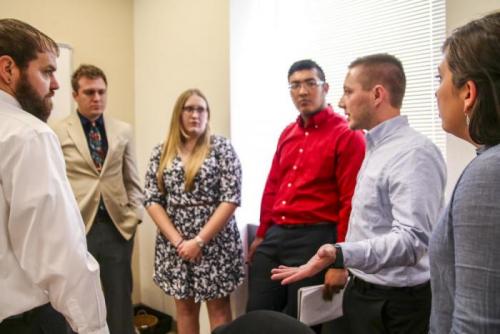
Now imagine this: young men and women armed with laptop and paper full of notes and scribbles, arguing about renewable energies, emission reductions, and carbon taxes across tables with signs that say “Egypt”, “Australia”, “China”, “Tuvalu”, and other countries. What sounds like one of the sessions in Paris was actually a classroom setting, the highlight of an undergraduate geography class at the University of Oklahoma (OU) called “Managing for a Changing Climate”. The class, co-taught by staff and researchers of the South Central Climate Science Center (SC CSC) and faculty at OU, featured an interdisciplinary mix of human and physical geography, climate science, climate policy, and economics. Dr. Renee McPherson (one of the instructors of the course) explained that one of the goals of the class was to get the undergraduates more familiar with how climate policy is made, and why sometimes there is an agreement, like last December in Paris, and why sometimes there isn’t, like in 2014 in Lima (where last year’s climate conference was held). McPherson is the University co-director of the SC CSC and an Associate Professor in Geography at OU. She attended both the Paris conference last year and its predecessor in Lima (2014) as an observer. “Policy isn’t this quantitative process, that if you go through step one, step two, step three, you’re always going to get an agreement at the end.”
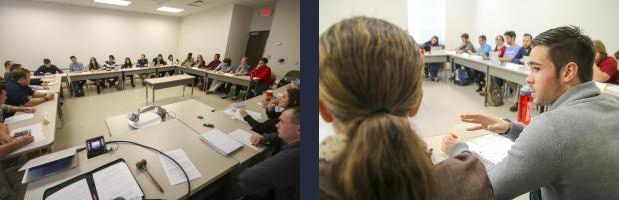
Leading up to its own (mock) conference, the class focused on hands-on experience in climate policy, but also featured traditional lectures on economics and climate science. In addition to lectures, students were assigned into teams to represent one of ten countries. Students researched the culture and background of their country to determine which one of the three prescribed policies – renewables, lower emissions, or carbon taxes – to advocate for and defend in a mock climate conference at the end of the semester. “The science has gotten better over the years, and more and more policy leaders are convinced by the science,” says McPherson. Indeed, last year’s negotiations were not so much about whether the climate science was real but what to do about global warming, how to work the problem, said Reid Detchon, Vice President for Energy and Climate Strategy at the United Nations Foundation, in a recent Climate Voices webinar.
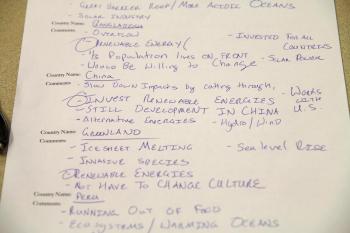
For Cameron Conyers, a junior majoring in Environmental Sustainability, the mock negotiations made it a “top-notch class”. Teams didn’t just establish their own position, but also considered everyone else’s strategy in order to form stronger alliances. “No one wanted to be the loser”, he remembers. “We looked at targets of each of the other countries, met with their representatives, even outside of class, and hashed out side agreements to pull them onto our side.” At the end of tough negotiations, 9 out of the 10 countries voted for investing in renewable energies, and one voted for carbon taxes.


Back to the real world of policy-making, the class finished with a review of the conference in Paris by two of the instructors. Dr. Berrien Moore, Professor in Meteorology and also Dean of the College of Atmospheric and Geographic Sciences at OU, gave a summary of the progress. Dr. McPherson joined via Skype live from the Conference of the Parties (COP21) negotiations to give a feel for the vibe at the meeting, which was overshadowed by the terrorist attacks that had France still in shock. “Any time that a delegate from a different nation came up and spoke, they always prefaced it by some comment [about the terror attacks], like their heartfelt feelings for the people of Paris and the nation of France,” McPherson remembers. In her opinion, the Paris attacks played an important role in the success of the conference. “There was almost a sense that a lot of the nations wanted Paris to have an opportunity to, you know, rise on the pedestal.”
“Managing for a Changing Climate” will be offered again as a Massive Open Online Course (MOOC) this coming fall semester at the University of Oklahoma. To receive college credit, students need to be enrolled as OU students, but anyone with internet access who is interested can participate for free (though without getting credit). Follow janux.ou.edu and the South Central Climate Science Center on Facebook and Twitter for updates. The class instructors presented this course at the 2016 annual meeting of the American Meteorological Society. Download their poster here.
The course was made possibly by the generosity and collaborative spirit of the OU College of Atmospheric and Geographic Sciences, the Oklahoma Space Grant Consortium (supported by NASA), and the South Central Climate Science Center (supported by the USGS).

 Early Career Climate Network