by Victoria A. Johnson
When severe weather strikes, receiving accurate and timely information can be the difference between life and death. For many people, their local broadcast meteorologist plays a critical role in this process, helping audiences stay safe by providing them with the information needed to make informed decisions about what to do and where to go (Henson, 2010; Wilson, 2008). They are considered trusted sources of information, as their consistent presence, expertise, and calm demeanor allow them to effectively communicate tornado-risk messages during hazardous weather events (Sherman-Morris, 2005; Rainear et al., 2022). Despite their importance, however, a broadcast meteorologist’s severe weather coverage is not always sufficient. If local broadcast meteorologists’ messages are not accurate, or worse, fail to adequately warn those in harm’s way, there can be serious consequences in terms of public safety and trust.
In times of severe weather, some communities may experience inconsistent or incomplete tornado warning communication from their local broadcast meteorologist. This lack of coverage has been attributed to the tendency for broadcast meteorologists to shift where they focus their attention geographically throughout an event (Cario, 2016; Ebner, 2013; Johnson, 2022). In these situations, larger and more densely populated areas such as cities and suburbs receive extensive coverage of active tornado warnings, including detailed storm tracking and discussion of its direction, lead time, and magnitude. However, once these storms begin impacting neighboring rural and less populated areas, broadcast meteorologists opt to focus on reporting damage shots and human-interest stories from storms that occurred earlier in the event. This shift in coverage poses a significant threat to rural residents, as they are often left without active tornado risk communication when they need it the most. Furthermore, these observations highlight the potential for broadcast meteorologists to sometimes fall short of providing adequate warning communication to those at risk.
As a researcher studying severe weather communication, I couldn’t help but wonder: Why do some places receive disproportionate levels of severe weather coverage, and what can we do to improve it? In this article, we’ll explore the complex factors that shape how broadcast meteorologists communicate during severe weather and examine potential solutions to ensure everyone has access to weather warning information, regardless of where they live. I focus my research on Oklahoma, a region known for its volatile weather patterns, and I purposefully sample a group of 20 talented broadcast meteorologists working across the state (Palinkas et al., 2015).
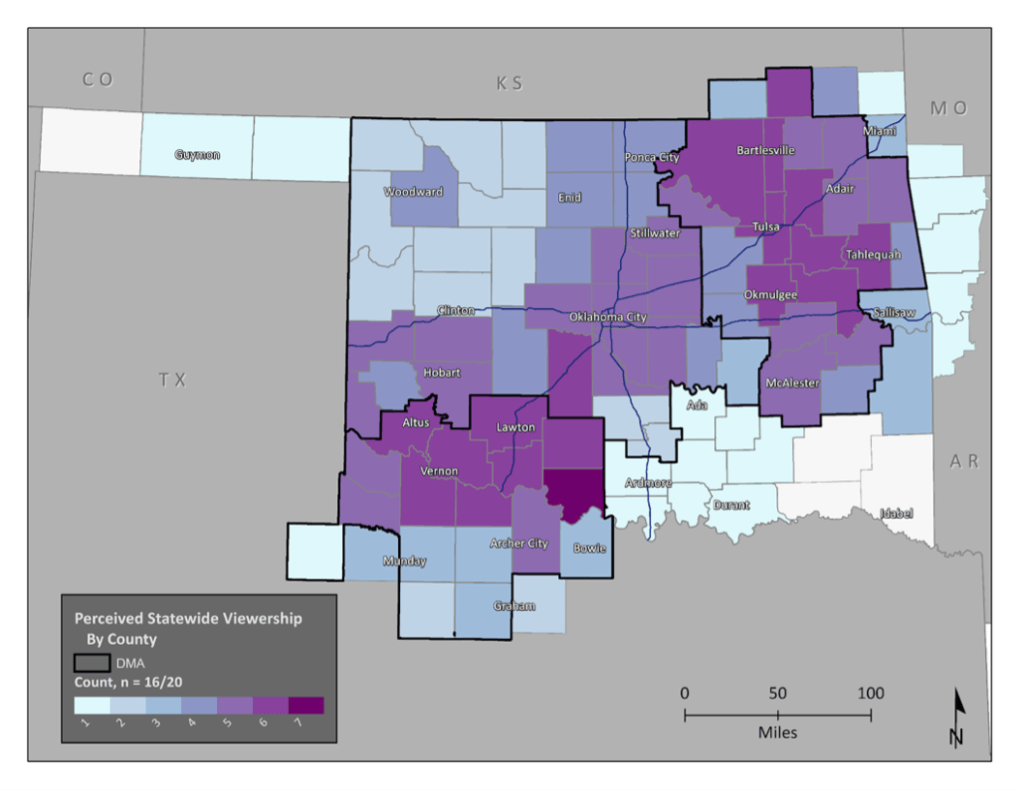
Deciding How and When to Provide Severe Weather Coverage As severe storms capable of producing tornadoes move into a DMA, local broadcast meteorologists must decide how and when they will provide live coverage structured around continuous, wall-to-wall engagement. One recurring theme that emerged from my research was the emphasis placed on providing coverage for urban areas more than their rural counterparts. When looking across Oklahoma, I noticed that broadcast meteorologists tend to focus less on the counties to the north-northeast and south of the state (Figure 1). These areas have fewer people and are mostly open farmlands. The preference for urban areas, where higher viewership is anticipated, was evident, while less populous and rural places appeared to be geographically isolated and received little attention (Figure 1). Their choices also align with the path of Interstate 44, a major highway that runs southwest-northeast through Oklahoma City and Tulsa. Thigh highway is uniquely positioned in that it coaligns with typical storm development patterns. As storms approach the State of Oklahoma and usually move northeast across the state, the I-44 corridor becomes a ripe spot for tornadic development. Therefore, broadcast meteorologists typically prioritize providing live coverage for mid-to-large population centers along the state’s highway, considering them as primary focal points.
Balancing Viewer Needs and Preferences
The urban-rural dynamic plays a pivotal role in determining how broadcast meteorologists structure their live coverage. One meteorologist that I spoke with mentioned that counties along the fringe of their DMA did not receive coverage for tornado warnings and were instead treated as severe thunderstorm warnings, which are only preempted during commercial breaks. In other scenarios, it appears that the programming on-air determines how they preempt and provide coverage, often with these decisions not solely resting with the meteorologists on staff. Station management and news producers will also place input on coverage decisions while considering revenue impacts and programming priorities. Striking a balance between information dissemination and the station’s operational requirements can lead to alternative methods being employed, such as text scrolls or graphics, to provide updates without interrupting regular programming. Notably, popular programs with high viewership, like sporting events and reality shows, aren’t always preempted. In such cases, viewers may see warnings displayed in the bottom corner of the screen.
Their tendency to prioritize urban areas over rural ones also stems from the assumption that viewers in densely populated regions possess greater understanding and preference for severe weather content. Rural communities are believed to show little interest and engagement until it directly impacts them. This highlighted an interesting paradox: while meteorologists accredited rural viewers in this region for having the highest weather knowledge in the country, they believed rural viewers faced challenges when it comes to identifying their location relative to a storm. This lack of spatial awareness can result in confusion and irrational reactions during storm events and can become especially problematic if these communities do not receive adequate coverage.
Overall, my research points to potential systemic issues that can hinder certain locales from receiving adequate and consistent reporting throughout a severe weather event that are based upon place-based decision-making practices. Remember, meteorologists are there to provide crucial information, but it’s up to you to stay informed and prepared. Stay connected to reliable weather sources, heed warnings and advisories, and take necessary precautions. When you’re weather-wise, you’re empowered to make the right choices when severe weather strikes.
Want to Learn More?
If you are interested in learning more about this special topic, please visit ShareOK and check out Victoria’s thesis!
References
Cario, A. (2016). Risk Communication in Local Television News. The University of Delaware [Thesis]
Ebner, D. M. (2013). A study of the Connection Between TV Meteorologists and Their Viewers During Severe Weather Broadcasts. The University of Missouri-Columbia [Thesis].
Henson, R. (2010). Weather on the Air: A History of Broadcast Meteorology. Springer.
Johnson, V. (2020). Designated Market Areas (DMAs) and Severe Weather Coverage: Oklahoma-Based Broadcast Meteorologists and Their Decisions for Providing Live, On-Air Coverage of Tornado Warned Storms. The University of Oklahoma [Thesis].
Palinkas, L. A., Horwitz, S. M., Green, C. A., Wisdom, J. P., Duan, N., & Hoagwood, K. (2015). Purposeful Sampling for Qualitative Data Collection and Analysis in Mixed Method Implementation Research. Administration and Policy in Mental Health and Mental Health Services Research, 42, 533-544.
Rainear, A. M., & Lachlan, K. A. (2022). The Station Scientist: Examining the Impact of Race and Sex of Broadcast Meteorologists on Credibility, Trust, and Information Retention. Frontiers in Communication, 7, 275.
Sherman-Morris, K. (2005). Tornadoes, Television and Trust— A Closer Look at the Influence of the Local Weathercaster During Severe Weather. Global Environmental Change Part B: Environmental Hazards, 6(4), 201-210.
Wilson, K. (2008). Television Weathercasters as Potentially Prominent Science Communicators. Public Understanding of Science, 17(1), 73-87.
Victoria A. Johnson is a Ph.D. candidate at the University of Oklahoma whose research examines how journalistic practices, such as place-making, inform tornado risk communication in digital settings. Her work centers around optimizing the dissemination of severe weather information to enhance the safety of local communities.

 Early Career Climate Network