
by Clay Tucker
In a recent short article for USM News, I wrote about the distant smoke from Canada’s wildfires making its way to the Gulf Coast. Little did I know at the time that smoke from another fire would also make its way into my backyard. I am originally from Baton Rouge, LA, but now spend much of the year in Hattiesburg, MS. The climate of these two places is quite similar: mild winters driven by weekly cold fronts and hot, sultry summers controlled by southerly winds from the 85-degree Gulf of Mexico. This has been true most of my life, and while winters can be drastically different (compare Christmas Day 2021 at 80 degrees and Christmas Day 2022 at 49 degrees), summers consist of 95-degree daytime highs and 85-degree nighttime lows. But let’s be real: summer 2023 was different.
Summer 2023 for the southeastern United States was hot, and I mean HOT. Climatologically, this summer has been a record breaker in my hometown: most consecutive days over 100 degrees (10 days), longest streak of 90+ high temperature days (99 days), hottest temperature ever recorded in Baton Rouge (105 degrees), and most days with heat index above 113 degrees (29 days) to name a few. Add to that the reason why temperatures were so hot: NO RAIN. I keep records for myself at home with a standard CoCORaHS rain gauge, and it has only recorded approximately six inches of rain in the past 3 months. To say that’s insanely low is an understatement. Since records began at Baton Rouge’s Ryan airport in 1930, no climatological summer (June, July, and August) has ever been drier, per the U.S. Drought Monitor.
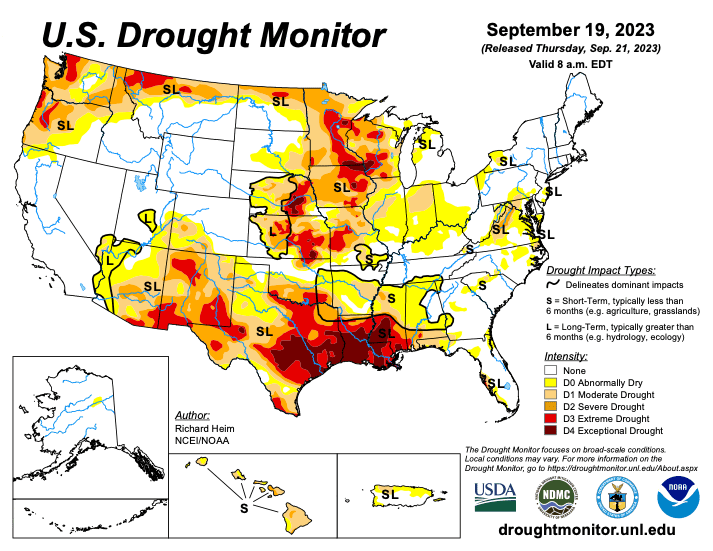
Louisianans are certainly accustomed to a hot summer, but this hot and dry is difficult for anyone. Excessive heat takes a toll on some of Louisiana’s most important financial and cultural resources. Global crawfish production is led by the ponds and swamps of South Louisiana. These crawfish rely on water to breathe; they do have gills after all. The summer of 2023 has left crawfishers in quite the conundrum: without some rains soon, not only will harvest be minimal compared to last year, it may be zero. Oh and the sugarcane farmers don’t know what to do either: plant now while there is SOME moisture in the soil or wait a few days to see if they’ll get lucky with a passing storm. Lest we forget this drought scenario is truly longer-term and larger-scale than just Louisiana summer 2023, migratory waterfowl are affected from Canada to the Gulf: dry conditions along a 2,000-mile flyway reduce habitat and food.
How does this all jive with wildfires in Canada, you ask? Well, there are now substantial wildfires in Louisiana. As a scientist who studies wildfire interactions, and as a certified prescribed burner myself, I understand this is natural – in some places. In fact, for a summer like this in the southeastern United States, I’d like to think that naturally most of the landscape would burn because of hot and dry conditions. Of course, we humans have halted that progress through concrete highways, irrigation, and other fire suppression methods, which come in handy when an out-of-control wildfire is barreling down on major cities. One such fire, the Tiger Island Fire, is the largest wildfire ever recorded in Louisiana. Yep, the wildfires are breaking records in Louisiana too.
While I’d love to expect the rains to begin in my home state soon, as a climatologist, I know that region is entering its driest time of the year right now through October, so I fear there’s not much relief coming. To borrow a phrase popularized by Dr. Katherine Hayhoe, I think this may be one of those summers when we’ve landed on a six that used to be a five…
Cover photo by Sardar Faizan on Unsplash
Clay is a postdoctoral tree-ring scientist at the University of Alabama. He graduated with a PhD in Geography at Louisiana State University in May 2020, and his dissertation research explores climate risk to cypress swamps and pine savannas on the Gulf Coast.

 Early Career Climate Network