
by Paulina Ćwik
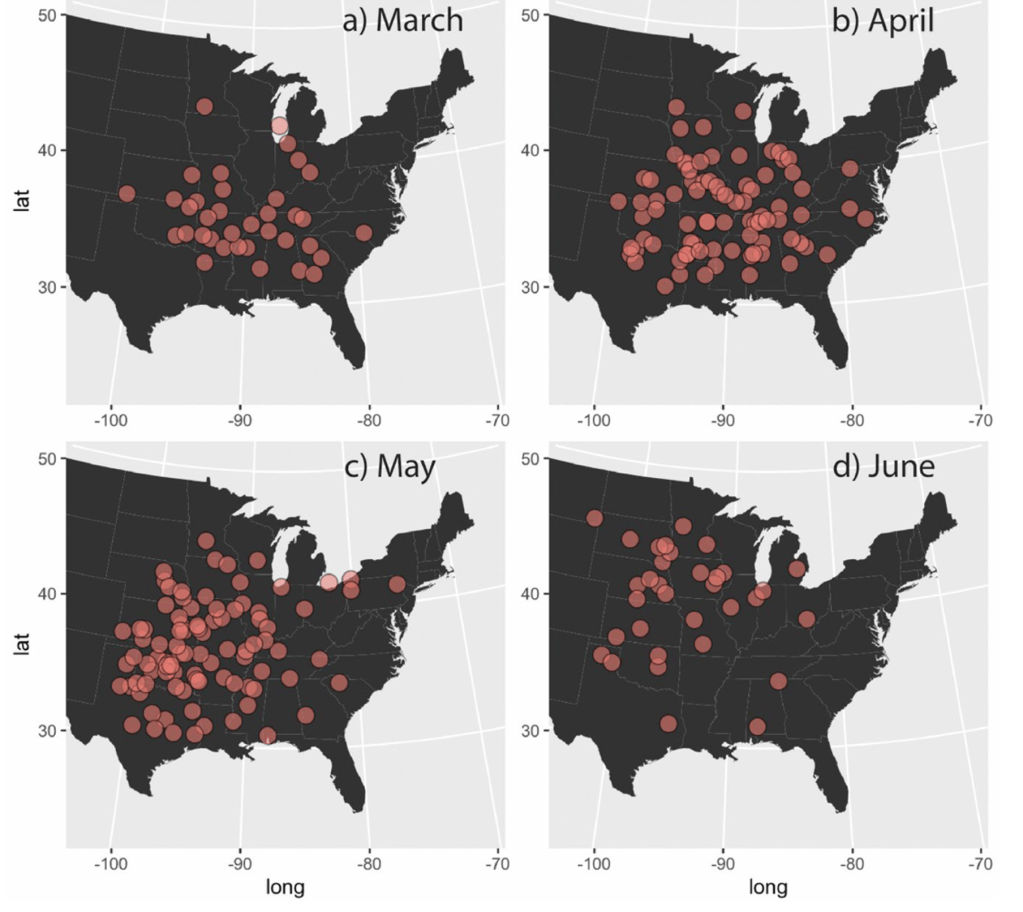
As the chill of winter recedes, giving way to spring’s warmth, the United States enters a critical season for severe weather, notably marked by the increased likelihood of tornado outbreaks. While tornadoes can occur year-round, it’s in the spring that conditions become particularly ripe for the most intense and widespread occurrences. Southern states typically experience these storms earlier in the season, while the northern areas prepare for activity as late spring unfolds. These natural disasters not only cause widespread destruction but also claim lives, making the prediction and understanding of their occurrences critically important. A recent study conducted by Ćwik et al. 2021 offers a comprehensive examination of the atmospheric conditions associated with tornado outbreaks, with a particular focus on May — historically recognized as the peak month for such occurrences (Fig. 1). This research provides valuable insights that could significantly enhance our understanding of the nature and characteristics of these outbreaks.
Uncovering Patterns Through Data
In their investigation, researchers from the University of Oklahoma and Mississippi State University, conducted a thorough analysis of the climatology of 500-hPa geopotential height anomalies associated with May tornado outbreaks from 1950 to 2019. Through examination of atmospheric conditions and application of statistical methodologies, their objective was to identify large-scale atmospheric patterns that precede these catastrophic events. At the core of the investigation were geopotential height anomalies at the 500 hPa pressure level. In simple terms, this refers to deviations in the height of the 500 hPa pressure level from its long-term average. These anomalies serve as indicator of atmospheric conditions, including the presence of high or low-pressure systems conductive to storm development and tornado outbreaks.
The research team identified 91 historical May tornado outbreaks, defining major outbreaks as those involving 7 or more tornadoes rated EF2 or higher on Fujita damage-based scale. They analyzed these events alongside atmospheric conditions to discern common patterns associated with them. Utilizing rotated principal component analysis, a statistical method facilitating the isolation of patterns in complex datasets, they revealed three primary atmospheric configurations (Fig. 2) linked to major May tornado outbreaks. Remarkably, two of these patterns (Pattern 2 and 3) had not been prominently identified in prior studies.

Cyclical Behavior and Future Predictions
One of the study’s most compelling discoveries is the cyclical nature of these atmospheric patterns. While the core characteristics of these patterns remain consistent over time, their geographic locations exhibit some degree of variability, especially on decadal and multidecadal scales. This finding is pivotal as it suggests that while we can anticipate the atmospheric setups conducive to tornado outbreaks, their exact impacts may shift geographically over time.
Additionally, this research not only deepens our understanding of the atmospheric dynamics leading to tornado outbreaks but also opens new avenues for future studies, particularly in the context of climate change. Through identification of these patterns and comparison with projected climate warming scenarios, scientists enhance their predictive capabilities regarding future tornado outbreak locations. This in turn, holds the potential for improved warning systems and enhanced preparedness measures
As we continue to witness the impacts of climate change, understanding the nuances of these large-scale atmospheric patterns becomes ever more critical. This research, along with similar studies, underscores the importance of merging historical data with analytical techniques to prepare for and mitigate severe weather events, and highlights how, despite the complexity of tornado forecasting, such efforts bring us closer to a future where communities can be warned with greater accuracy. As we improve our predictive models and expand our knowledge, we progress towards a future in which communities are better equipped to anticipate and mitigate the devastating impacts of natural disasters, potentially saving lives and minimizing damage in an increasingly warming world.

 Early Career Climate Network