
by Jay Wimhurst
In a nutshell:
- There are a great deal of insights emerging from both climate science and management of the Mississippi River Basin (MRB)
- This study sampled 2,150 documents starting in 1990, including journal articles, federal/state government reports, non-government factsheets, and published books about the MRB
- The study used topic modeling and mapping to evaluate how priorities and research agendas have changed over time and across the landscape of the MRB
- Goals include highlighting the complexity of human-environment interactions in the MRB for researchers interested in using topic modeling
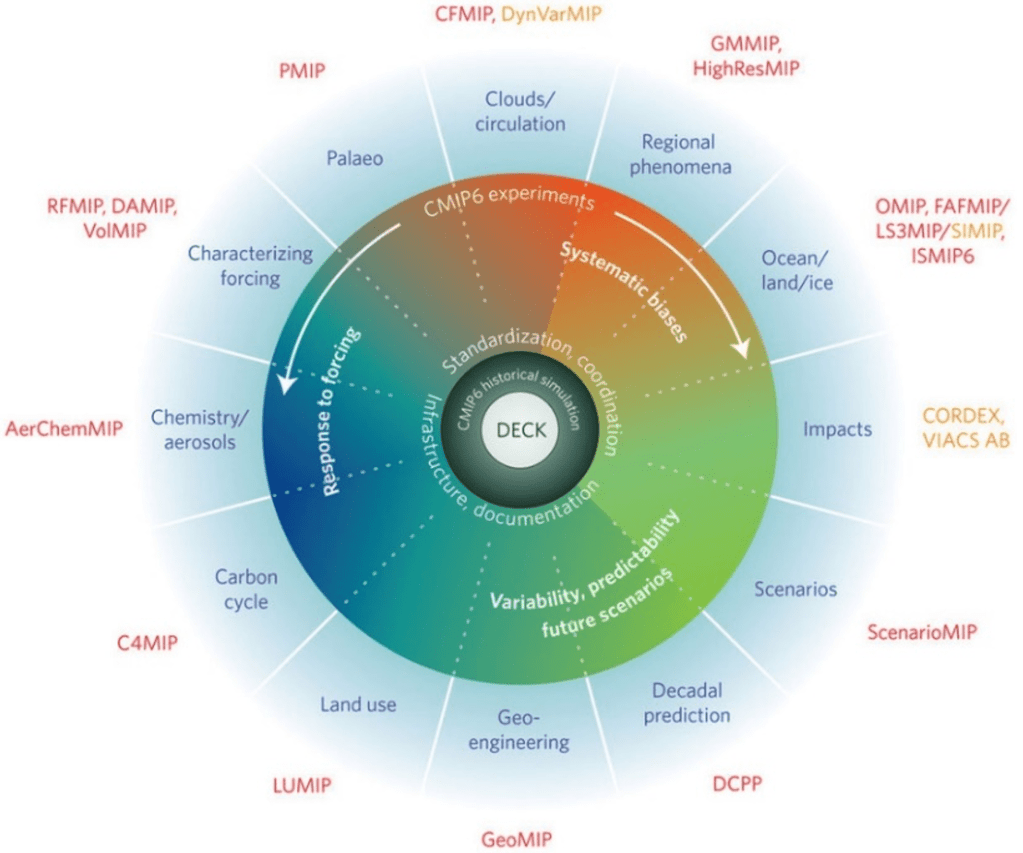
Humanity’s increasing understanding of the climate system has afforded great strides in modeling finer-resolution and more complex climate components (such as cloud physics and biogeochemistry), as reflected in the Sixth Phase of the Coupled Model Intercomparison Project (Figure 1). More recent years have focused on enhancement of climate system understanding beyond model development. For instance, the United States’ Fifth National Climate Assessment (NCA) advocates for and incorporates an interdisciplinary approach that considers climate science’s synergy and relevance to other areas of science.
The NCA also utilizes traditional and Indigenous knowledge to enhance and decolonize climate management recommendations, and communicates the need for climate change action creatively through its “Art x Climate” gallery. Climate science does not exist in isolation, and in fact impacts and mutually benefits from the arts, humanities, and physical/social science. In my research’s context, understanding the connections between hydrologic systems and land use could improve by incorporating local priorities and knowledge about the land, and human perception of climate change risks to hydrologic systems.
As such, community engagement that meets socio-environmental and political challenges facilitates improved climate change management (such as work done by the USGS Climate Adaptation Science Centers), made possible by supplementing the findings of disciplines relevant to the climate science questions at hand.
My research embraces this interdisciplinary approach to climate science by exploring the interlinked human-environmental challenges facing the Mississippi River Basin (MRB), thereby identifying its priority research questions and climate change management challenges. Specifically, I focus on the identification of past and current research foci as well as understudied research areas that will require more attention in the future. A cursory Google Scholar or Web of Science search will show that the MRB faces many regionally specific human-environmental challenges, such as wetland subsidence in Louisiana, edge-of-field agricultural runoff in Arkansas, and seasonal bird migration behavior in Minnesota and Iowa. These regional challenges are also spatially interconnected basin-wide (for instance, land-use change upstream exacerbates downstream high-flow events in the Mississippi Delta), as well as changing over time in priority (for instance, research about stakeholder needs in MRB management first appeared only in the mid-2010s). These examples attest to the relevance of ecology, biogeochemistry, and urban planning to the spatiotemporal heterogeneity of the MRB’s research challenges, all of which (and more) are further complicated by climate change.
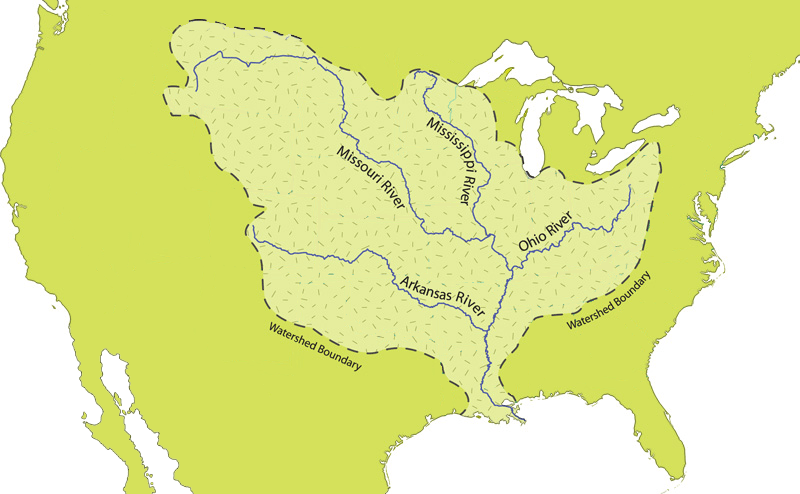
The question that my work ultimately poses is how research trends and priorities across the MRB have evolved spatiotemporally since the 1990s, and how knowledge of these trends and priorities should consequently inform the MRB’s ongoing and future climate change research and management. Answering this question first requires the mining of journal articles, federal/state government reports, non-government factsheets, and published books in which the Mississippi River (or the MRB as a whole) is the topic focus, followed by Natural Language Processing (specifically topic modeling) of the mined documents for keywords and phrases. Application of rigorous quality control to these documents (e.g., the Mississippi River/MRB must be mentioned in the title, abstract and/or keywords; publication year 1990 onward in accordance with the publication of the Intergovernmental Panel on Climate Change’s First Assessment Report) yielded 2,158 documents, on topics ranging from invasive fish species to wetland restoration to urban development following extreme flood events. Some topics appear more frequently than others in certain publication years or sub-regions of the MRB. Some topics also appear in conjunction with mentions of climate change in the same document, ranging from pithy remarks to detailed analyses.
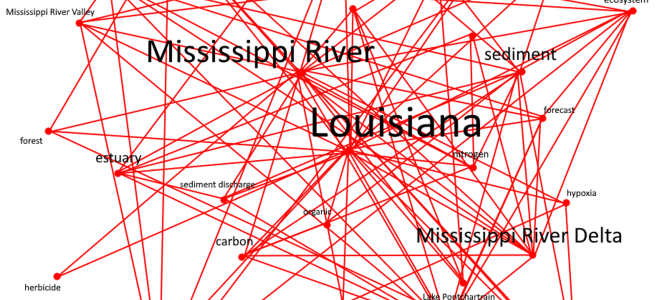
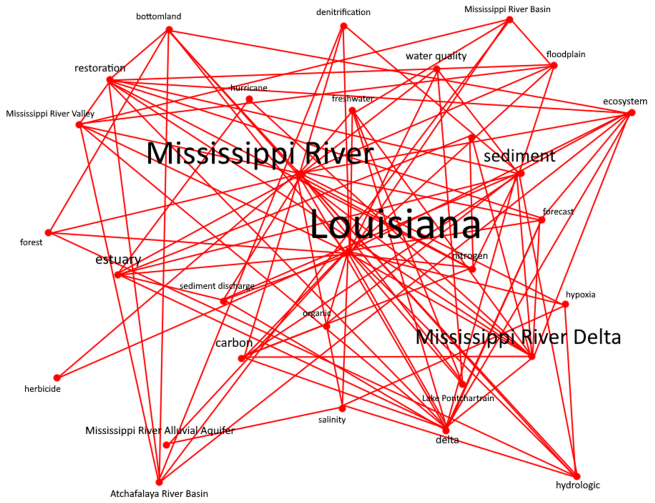
Capturing this spatiotemporal heterogeneity in the MRB’s human-environmental research is achieved by construction of topic model maps that statistically identify these documents’ most common words and phrases (excluding commonplace verbs, nouns, and stop words). As illustrated by Figure 2, the most frequently appearing words and phrases in Mississippi River/MRB studies performed over Louisiana are the largest. In addition, links between words/phrases convey those used in the same documents. Such quantification of word/phrase frequency and association enables sensitivity analysis of the developed topic model, specifically comparing the topic model maps generated for different states and different decades, thus illustrating the variability of common MRB research topics. Sensitivity also comes from the selected topic modeling approach, such as Latent Dirichlet Allocation or Correlated Topic Models. Each approach’s reliance on different probability distributions, and assumed randomness in topic/word/phrase order or lack thereof, could result in quite different topic model maps for the same state or decade.
Examining several topic model maps together will illustrate and quantify local and state-level concentrations of research into specific topics pertaining to the MRB, as well as how these topics have changed over time as new ones enter the purview of scientific interest. One’s perception of these maps, and thus of the most pressing climate change research/management priorities, will also be sensitive to the chosen topic modeling approach. It is my hope, therefore, that this work will spotlight the growing prevalence of climate change and interdisciplinary thinking (as opposed to siloed research in separate disciplines) in MRB research, along with potential directions for future research. Such findings will be vital for identifying topics that should be prioritized for funded research in the years to come, especially given the explicit interest being placed in “convergence research” by the National Science Foundation.
My research’s core outcome is for scientists who enlist this topic modeling approach to develop a greater appreciation for the complexity of the human-environmental challenges facing the MRB, and the consequences of these challenges for climate change management. This approach could even be applied to interdisciplinary thinking in other climate change management contexts, furthering the exploration of existing literature to systematically, visually, and quantitatively identify valuable, high-demand research directions.
Joshua Jay Wimhurst has a PhD in Geography and Environmental Sustainability at the University of Oklahoma. Previous research areas: identifying trends from rain gauges across the tropical Pacific Ocean; attributing Oklahoma’s future wind energy resources to evolution of the Central Plains low-level jet. Current research areas: developing climate change and flood risk resources with communities along the Gulf Coast; building a SES model that predicts best future wind turbine locations across the US. See Jay’s research publications here.

 Early Career Climate Network