In addition to research and education, U.S. land-grant universities have a third mission: bringing the institution’s research and resources into its state’s communities. The Cooperative Extension Service fulfills this mission, with a presence in nearly all of the country’s 3,000 counties. Extension professionals provide their local communities with timely, geographically specific scientific information. They conduct site visits, workshops, and other events. And they create spaces for communities to make their voices heard. In other words, Extension work is the epitome of applied science communication and public engagement.
Climate change touches every Extension program area, from agriculture to youth development. So during my master’s program in climate change communication, I started to wonder—what climate communication lessons can we learn from Extension educators, who are on the ground engaging with local communities day in and day out? That question grew into my master’s thesis. I used a qualitative approach to produce rich and nuanced data complementing previous quantitative work.

I did semi-structured interviews with four Wisconsin Extension educators in Crops & Soils, seven in Community Economic Development, and four in Financial Education, as well as the program managers from those three areas. The educators I interviewed cover a broad range of urban and rural communities all over the state. They have between 6 months and 30 years of experience in Extension. Some, especially in Crops & Soils, do a lot of climate-related work, while others, especially in Financial Education, view their work as tangential to climate change, if related at all. But as I dug into these conversations, I found that all of them had important climate communication insights.
Specific, Local, and Relatable
In many contexts, like international policy negotiations, we need to talk frankly and directly about climate change. However, many Extension educators work in rural and conservative areas where the term “climate change” is a political lightning rod. In fact, one educator said that it’s just as polarizing as the phrase “diversity, equity, and inclusion”—but a better choice of words can overcome the polarization because “the words are what they object to, not necessarily to the activities that are being done under those words.” Some other phrases that educators have found success with include “climate variability,” “changing weather patterns,” “extreme weather,” and even “changing climate.”
So words matter. But even if you choose the right words to talk about the overarching topic, sometimes it’s still too broad and amorphous. One educator told me, “As important as climate change is, sometimes I worry we spend too much time fixated on the concept and the words ‘climate change’ as opposed to just being on the ground and doing the solutions.”
So what does that look like in Extension? It’s specific, local, and relatable. As one example, a major climate impact in Wisconsin is that the northern part of the state is getting a lot less winter snowfall than it used to. That makes it harder to have good snowmobiling and skiing, which are important to the local culture and normally draw a lot of tourists. So that means less income for seasonal workers. One educator told me, “Focusing on it from an economic perspective [is] the safest way to engage with people. […] Saying ‘the amount of carbon we released is causing the lack of snowfall’ is probably not going to start a fruitful discussion.”
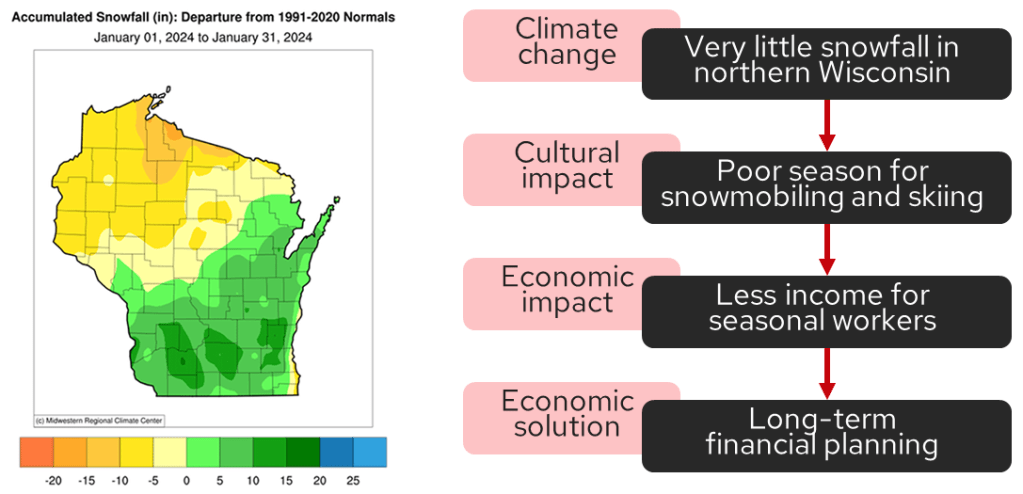
In this chain of events, the only thing that matters about climate change is that it’s a long-term trend, not a one-off event, so it necessitates long-term financial planning. One educator approaches conversations with clients like this: “It’s more goal-setting. […] What does this mean, yes for right now, but also […] for next year? […] What kind of steps can you take? […] Because this could happen again next year.” So even if they’re not talking directly about climate change, they are taking it into consideration as something that’s affecting the work that they’re doing, and they’re helping people adapt.
Going in the Back Door
At this point, you might be thinking, “Okay, so that’s helping with adaptation—but that doesn’t get us anywhere with reducing greenhouse gas emissions.” I found that some educators have good strategies for getting at that part of the equation as well. I like to call their approach “going in the back door.” As one educator put it, “It’s not necessarily saying, ‘Well, this would be the best way we should go because it’s good for the climate.’ Oftentimes it’s, ‘This is the best way to go because it would be beneficial to your particular interests, your particular costs. And it helps the environment too.’”
In a lot of abstract discussions about climate change communication, we get caught up asking, “How should we frame the umbrella topic of climate change? As a public health issue? An economic issue? A national security issue?” In Extension, that’s the wrong question to ask. Instead, Extension professionals ask: “What does my audience value, and what is going on in their lives?”
An educator working with a farmer is going to be talking about soil health. An educator working with a low-income individual struggling to pay rent is going to be talking about using less energy to save money on bills. All these things have climate change mitigation benefits—that’s just not what the educator emphasizes. It’s an undercurrent, it’s secondary to what directly matters to the person. And if they’re talking about the changing climate at all, they’re talking about in terms of resilience, which is much more tangible and empowering than the global problem of mitigation.
How You Can Help
If you’re a climate change researcher or communicator, you can help by producing local, industry-specific resources, which many educators told me are currently lacking. What do increased droughts mean for snap pea production? What do more frequent and severe natural disasters mean for home insurance rates? Even better, you could put together a case study of how a local community has addressed a climate-related challenge and how other communities can learn from that success.
Here’s how one educator summed up the way forward:
“First, there’s learning about what is climate change, right? What does climate change mean for Wisconsin? And then breaking it down to what does climate change mean to the folks that I work with, to my county? And then how do I get that word out? And how do I start incorporating those pieces into the programming that I already do?”
As exemplified by Extension’s approach, climate communicators can spur people to action by cultivating a hope that is active, not passive. We each have the ability to be resilient in the face of the changes that we are experiencing. And when we act in community rather than alone, our actions will make a meaningful difference in building a better world for the generations to come.
Scott Hershberger has an MS in science communication from the University of Wisconsin–Madison. He is passionate about advancing local climate solutions through strategic and empathetic communication, outreach, and public engagement. Scott is currently a forestry communications specialist with UW–Madison Extension. His writing has been published by Scientific American, Fermilab, the American Mathematical Society, TED-Ed, SciShow, and other organizations, and he has conducted social science research to support maple syrup producers and farmers markets.

 Early Career Climate Network