Clay Tucker, Lindsey Middleton, Paulina Cwik
The Early Career Climate Network (ECCN) began over 12 years ago at the Northwest Climate Bootcamp, an early-career workshop hosted by the Northwest Climate Adaptation Science Center. Graduate students and young faculty came together after that meeting to stay connected, support each other, and share ideas through the ECCN. Since that time, our writers have demonstrated various results of their research, provided insights into a career in climate science, and shared thoughts on how to communicate climatological information.
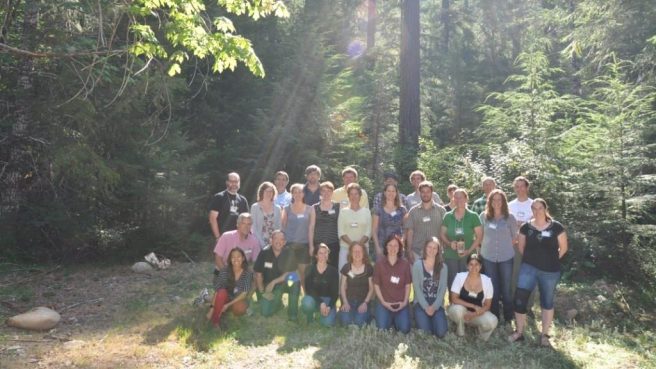
Though many of the original founders have moved on in their careers, the ECCN community remains active—sharing opportunities, exchanging ideas, and supporting the next generation of climate professionals. In celebration of ECCN’s 12th anniversary, several past and current members share their thoughts and reflections on ECCN and what the network has meant to them.
“ECCN has been an important platform for growing community and skills around science communication. I teach science communication in every aspect of what I do as part of my job – from mentoring students on their theses, prepping for poster and powerpoint presentations at scientific meetings, in lab group meetings, and in the classroom. My time with the ECCN (from the days of ECCF) really increased my valuation of communicating and engaging with diverse audiences and learning about other ways of doing science from those working on everything from the physical to social sciences.”
“Finding ways to connect and communicate across disciplinary and geographical boundaries is so important when we are studying and tackling complex, global problems like climate change. And I think particularly for early career researchers, it can oftentimes be hard to find spaces—whether online or in person—that truly promote and support that sort of engagement. ECCN has been one of those spaces for the past decade or so and I know it has played an important role in supporting many early career climate researchers find and engage with one another.”
“My experiences from ECCN, especially hosting our science podcast from 2019 to 2021 and the sci-comm workshops in 2016 and 2020, and blogging, are something I still draw from a lot. I am writing this as I am attending an early-career science communication workshop in Germany (where I’ve moved back to in 2021). Just over lunch I brainstormed with peers from chemistry to medicine about formats for better engaging with non-science actors and for better getting researchers to leave their ivory tower bubble and engage more with non-researchers. The issues from back then are not limited to climate change and have changed little – and neither has the need for ECCN.”
“In creating ECCN, the idea was to allow early career professionals working in climate, from the physical scientists to the social scientists and then some, to connect, collaborate, and create. Connect each to others outside their discipline. Collaborate on research related to climate. Create new knowledge and insights to inform society and help to better the human experience. The necessary C’s require an additional consideration of viewpoint diversity. ECCN has the potential to build understanding of and respect for viewpoint diversity among its members, which form the next generation of climate professionals, and between its members and the public. Therein lies the real potential value of ECCN that, though yet to be realized, could help make a major contribution to climate science in society.”
“ECCN began for me as an opportunity to share my early career experience with those who had similar experiences. We were going to conferences together, reading the same research, and talking about the same ideas. Eventually, ECCN morphed into an outlet and practice for writing about my research and about my thoughts in climate science. ECCN is now for me a beautiful memory of my first experience in shared governance. We all relied on each other to keep the meetings, the website, and the blog running, and we all shared responsibility and ownership of the ECCN. It was a small group of us, but I’m proud of the work we accomplished together.”
“I joined ECCN originally to connect with other early-career scientists in a similar position to me, in terms of what we were all doing and what we were all worried about and researching and experiencing. I’m not working in climate services anymore, because I went back to restoration ecology, but I have fond memories of the ECCN. I hope we reached folks through the blog that would’ve otherwise not been reached, and I hope it continues to be a resource for everyone participating in it!”
“As a science communication researcher, I really enjoy getting to learn from early career climate researchers and professionals. Climate researchers come from such a wide variety of disciplines, there’s always something new to learn. Beyond facilitating connections and new content from these researchers, though, I’ve very much enjoyed collaborating with the board to not only support everyone’s skill sets and passions, like Toni’s podcasting (which we miss!), but also to build sustaining connections I hope to carry with me throughout my career.”
“For me, ECCN has been an invaluable outlet to practice concise, accessible science writing through blog posts, challenging me to communicate complex ideas with clarity and precision. But my involvement went far beyond writing. I had the opportunity to engage with a wide network of contributors, reaching out to new authors, reviewing and editing their work, and offering feedback to help refine their ideas into publishable pieces. These collaborative exchanges helped strengthen not just the final blog posts but also the sense of community among early-career professionals. ECCN also served as a space to share job opportunities, support others navigating the post-graduate transition, and connect with peers across disciplines and institutions. I’m proud to have played a role in such a dynamic and inclusive initiative, and I’m excited to see how ECCN continues to empower the next generation of climate scientists.”
Honorable mentions: Thank you so much to Ashley Booth and Victoria Johnson for taking part in our editorial board and blog series and helping manage our online media, thank you to all our collaborators and authors over the years, and thank you to supporters at various universities and organizations we have partnered with.
As ECCN enters its next chapter, it stands as a testament to what can grow from a shared commitment to connection and mutual support. It has become a place where early-career climate professionals can exchange perspectives, build confidence in their voice, and contribute to a broader dialogue in climate science. The reflections shared here underscore how meaningful small acts—writing a post, mentoring a peer, offering feedback—can shape a professional path. As we look ahead, we remain grateful for the community that has formed and hopeful for the new contributions and connections still to come.
Here’s to the next generation of ECCN leadership and collaboration.

 Early Career Climate Network